
How a Meme, a Friendship, and a Roomful of Kids Led to a Children’s Book
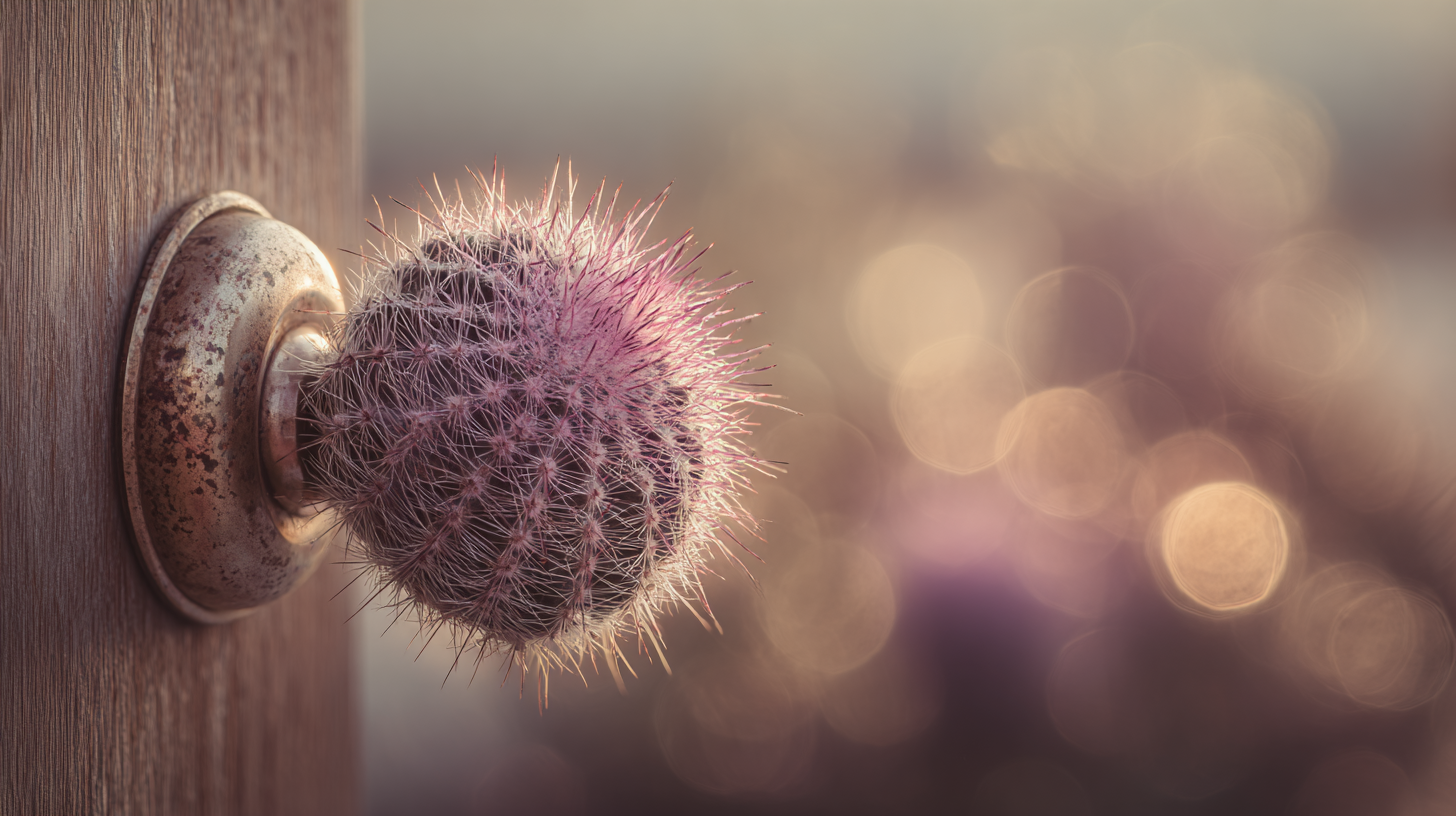
I was sitting in my therapy office when I saw it. A meme on Facebook: a doorknob made entirely of cactus, round and covered in spines. The caption read: Therapist: “You need to let people in.” Me: “It’s not locked.”
I laughed out loud. Saved it to my phone. Filed it away under “things to show clients someday.”
I didn’t know it yet, but that cactus doorknob was the start of a book.
A Shared Language
Around that time, I met someone I clicked with right away through an online community. We became friends. During one conversation, she said I wasn’t her typical friend. I had no idea what she meant. As we talked, she shared that she often kept people at a comfortable distance. She wanted to try having our friendship be a true friendship. I was honored.
 I said, “I have a meme for that.”
I sent her the cactus doorknob.
She laughed. She got it immediately. And from that point on, it became our shorthand. When her prickly protective part showed up, we called it her cactus part. No long explanation needed. Just: “My cactus doorknob is out now.” That was enough.
In IFS, we talk about parts like this all the time. The part that keeps people at arm’s length or the part that hides. Every part has a reason for being there and is trying to protect something tender underneath.
But here’s what I noticed: the doorknob made it easier to talk about. It made a clinical concept feel approachable. It was funny and felt safer. It normalized something people might think of as a negative thing.
Creative Sparks
A few weeks later, I was with a therapist friend, and the cactus doorknob came up. We started laughing about it, and then we started being creative.
“Okay, so that’s the cactus doorknob. What about anger? What would that doorknob look like?”
“How about lava?”
“And the people-pleaser?”
“Something warm and comforting. Well, we can’t put a blanket on a doorknob. How about a pom-pom?”
“Someone who doesn’t want to be seen?”
That one was mine. “An invisible one. Like a clear bubble that can only be seen in certain light.”
We went back and forth for a while. I pulled out my phone and started typing them into my notes app. A cactus. A lava knob. A disco ball for the kid who performs so no one looks too close. A frozen doorknob to show someone who freezes.
It was fun. Just two therapists being creative on a random afternoon.
I saved the note and forgot about it.
The Accidental Discovery
Months later, I was at my writing cohort. I was supposed to be editing a piece of work. It was tedious, the kind of editing that makes your eyes glaze over. My attention drifted to my phone.
I was scrolling through old notes when I saw it. The doorknob list.
Cactus. Lava. Disco ball. Bubble. Pom-pom. Frozen.
I read through it and something clicked. This was a book. A children’s book. Each doorknob could open to a different part, and kids could meet them one by one. They could learn that every part, even the scary or confusing ones, has a story and a good reason for being there.
I texted my friend, the one with the cactus part. She had her own publishing company. “Want to make a children’s book with me?”
She said yes.
Why a Children’s Book?
I could have written this for adults. I could have written a workbook or a clinical guide. But a children’s book felt right.
Years before any of this, I worked as a case manager supporting people with intellectual disabilities. One of the people I supported, a man I’ll call Michael, wanted to teach children something simple: “We are more alike than different.” We developed a presentation together and brought it to my daughter Ashley’s elementary school classroom.
The kids leaned in. They had questions. When we talked about adaptive equipment, wheelchairs, glasses, hearing aids, toddler silverware, one by one every kid realized they already knew someone who used something like that. The fear left the room and curiosity took its place.
That day taught me something I never forgot: children are not afraid of these conversations and don’t need to be protected from complexity. They just need someone to open a door and invite them into a conversation.
A hallway full of doors felt like the right way.
What I Wish I’d Had
There’s a personal thread in this too.
When I was a kid, I had parts working overtime. I had parts telling me to be strong and to hide. Another part told me to take care of everyone around me before I even thought about myself. I didn’t have a name for any of them. I just thought something about me was too much, or not enough, or somehow wrong.
After years of training, therapy, and my own IFS work, I understood that those parts weren’t flaws. They were survival strategies trying to help me in the only ways they knew how.
I think about the kid I was and what it would have meant to open a book and see: every part of you has a story and a reason for being there. Every part deserves kindness.
That’s why I wrote this book.
The Book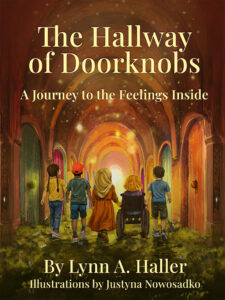
Last week, you saw the cover of The Hallway of Doorknobs: A Journey to the Feelings Inside. Now you know the story behind it.
The book follows a group of children who discover a hallway they’ve never noticed before. The floor is soft like moss. The walls shimmer like stars. And each door has a different doorknob. A cactus. A lava knob. A disco ball. A bubble. A pom-pom. A balloon and a bolt of lightning. A frozen snowball.
Behind each door, they meet a part. And each part, no matter how prickly or loud or invisible, has something to say about why it’s there.
What’s Coming
Next week, I’ll take you behind the scenes with the illustrator, including the story of how she worked with me and my publisher to bring these parts to life. The following week, you’ll get to meet one of the parts from the hallway. And on May 4, the book launches.
Pre-order The Hallway of Doorknobs: A Journey to the Feelings Inside
If you want to follow along, subscribe below so you don’t miss anything.
A Moment of Reflection
Think about the memes or images you’ve saved on your phone. The ones that made you laugh because they were a little too accurate.
What part of you did they capture?
If you could give that part a doorknob, what would it look like?
And what might it say if you opened the door and listened?
This post discusses concepts of Internal Family Systems (IFS) by Dr. Richard Schwartz, founder of IFS. The IFS framework shapes how I teach, write, and support healing.

- Schlow Centre Region Library Meet the Authors Event - October 19, 2026
- Behind the name: Jack - October 12, 2026
- Behind the name: Sara - October 7, 2026
Hey, I remember that day when we were making up different doorknobs and laughing.
I’m delighted that our fun conversation was a spark for this book.
I felt a little choked up when you shared about the gentleman who wanted to teach children that we are more alike than different. I remember him, and I remember how much it meant to him that you did that with him. What a beautiful way to help him and the kids.
I honestly believe that this book will help so many children.