
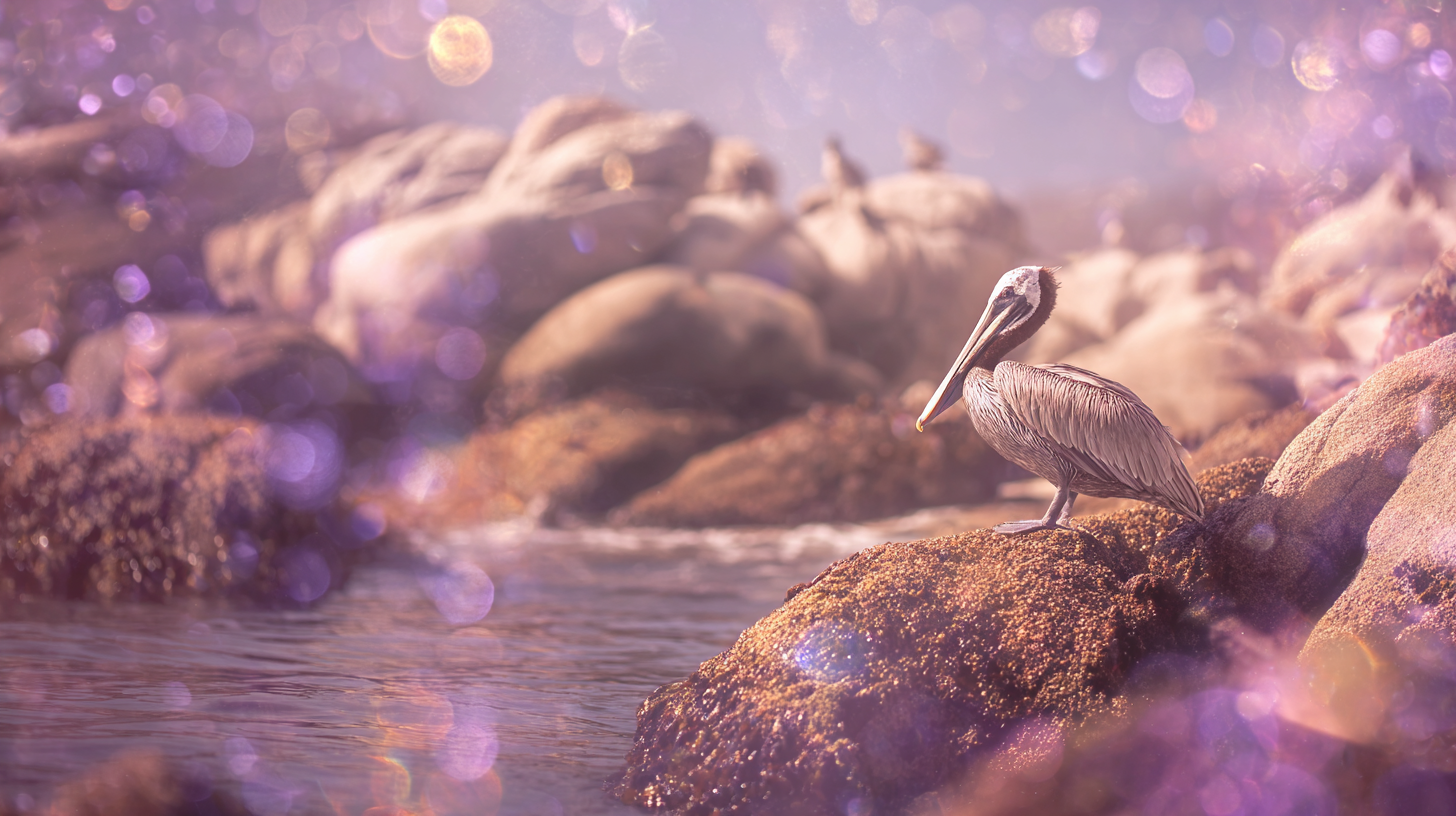
What the Pelicans Taught Me
The Bend in the Shore
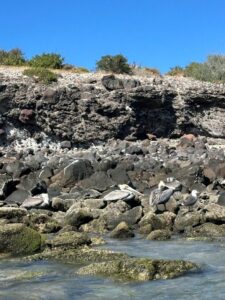 We paddled around the bend at Playa Pichilingue, tired and ready to turn back. The water was calm, the sun warm on our shoulders. My sister Lori and I had been kayaking for about half an hour along the Mexican coast, taking in the volcanic rock formations and the deep blue of the Sea of Cortez.
Then I noticed a hint of yellow.
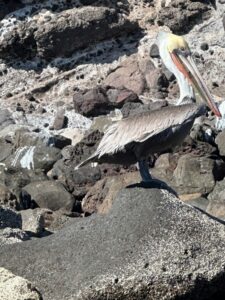
At first, the pelicans blended into the dark lava rock. But once I saw them, I couldn’t look away. There were at least half a dozen of them, massive, ancient-looking birds sunning themselves on the rocks. We paddled a little closer. I lifted my camera.
They were beautiful. The way their bodies tucked into themselves, beaks folded perfectly against their chests. Prehistoric and powerful.
Then one of them stood up.
It wasn’t aggressive, just a shift in posture. But suddenly, I felt the reality of where we were. These weren’t birds at a zoo behind glass. We were in their space. In a kayak. Very close.
 “We should paddle away,” I said quietly to Lori. “Slowly. Let’s not make them think we’re a threat.”
She glanced at the pelicans, then at me. “Yeah,” she agreed. “With my luck, one would come after me.”
We paddled backward, calm and deliberate, keeping our movements smooth. No splashing. No sudden turns. Just a quiet retreat.
The pelicans watched us go. Or maybe they didn’t. Either way, we left them to their rocks and their sun.
How We Got There
That moment, knowing when to retreat, trusting my judgment, staying calm despite the adrenaline, wasn’t just about the pelicans. It grew out of a choice I’d made months before: to travel differently.
In January 2024, my sister and I flew to Mexico. Not to a resort. Not on an organized tour. We rented a car, booked three different Airbnbs in three different locations, and planned to navigate it all ourselves.
I’d done plenty of independent travel in the U.S. Road trips and solo adventures. But this was different. This was another country and another language. Grocery stores where I’d need to read labels in Spanish. Gas stations where I’d need to ask for help. Moments where I couldn’t just default to English and assume someone would understand.
I’d taken four years of Spanish in high school, one more in college, and had lived in Southern California where I’d been immersed in it daily. But this was different. This was relying on it.
When I told people our plan, I got a lot of questions.
Why not just do a resort? Wouldn’t that be easier?
What if something goes wrong?
Are you sure you can navigate that on your own?
The truth? I wanted to experience the country. The culture. The people. I didn’t want to be trucked around with a large group of tourists, insulated from the place itself. I didn’t want a resort that could be anywhere, where the beach and the pool were interchangeable with a dozen other destinations.
I wanted Mexico. Real Mexico. The parts you only find when you’re willing to get a little lost.
Playa Pichilingue
The drive from La Paz to Playa Pichilingue felt like freedom.
Water on one side, cacti on the other. The road stretched out in front of us, and for the first time, I felt it fully: We made this happen. We researched and planned. We trusted ourselves to handle whatever came. And now we were here. Alive and present in the moment.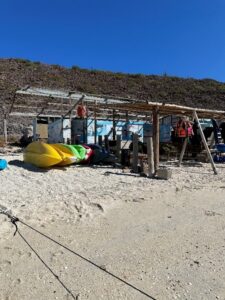
That feeling, the aliveness of it, was worth every bit of doubt I’d felt while planning.
I’d found Playa Pichilingue through a travel group on Facebook called Girls Love Travel. Someone had posted about the quiet beach, the small local kayak rental, and the amazing snorkeling. It wasn’t on the typical tourist route. It was just… there. Waiting to be discovered by people willing to look.
When we pulled up to the beach and saw the small wooden shack with colorful kayaks stacked under a makeshift shelter, I had a moment of doubt. Is this legit? Is this safe?
But then I thought: This is exactly what we came for.
We paid the local operator, chose our kayaks, and pushed off into the warm, clear water.
What Confidence Looks Like
Confidence is quiet. It’s the ability to trust yourself, not bravado or proving something to anyone else. And to trust yourself to make a call in the moment and know you can handle what comes next.
When that pelican stood up, I didn’t freeze. I didn’t panic. I assessed. I made a decision. I communicated it to Lori. And we left.
Not because we were scared, though a cautious part of me definitely was. But because confidence also means knowing when not to push. When to respect boundaries. When retreat is the wise choice, not the cowardly one.
I didn’t need to get closer to prove I was brave. I didn’t need to risk an “unfortunate bird encounter.” I could already picture it: pelicans flying at us, beaks open, protecting their territory.
Confidence meant trusting that paddling away was the right move. And that it didn’t make us less capable. It made us smart.
What IFS Teaches Us About Confidence
In Internal Family Systems (IFS), confidence is one of the 8 Cs, a quality of Self. It’s not about never feeling doubt or fear. It’s about Self being able to lead even when protective parts are present.
When we were planning the Mexico trip, my parts showed up loud and clear:
The excited part wanted adventure and new experiences. The overwhelmed part worried about logistics. What if we got lost? What if something went wrong? And the cautious part whispered, Maybe a resort really would be easier.
But Self-energy was present. Clear. It said: We can do this. We’ll plan it out and trust ourselves to handle what comes.
And we did.
When we rounded that bend and saw the pelicans, those same parts showed up again. The cautious part said, We’re too close. This could go badly. The excited part wanted to stay and watch. The protective part wanted to make sure we were safe.
But Self-energy made the call: We’re leaving. Quietly. Calmly. And that’s the right choice.
Confidence in IFS isn’t about silencing your parts. It’s about hearing them and really taking time to understand their concerns. Only then can Self lead.
The Confidence That Keeps Building
That trip to Mexico taught me something I didn’t fully understand until later: confidence compounds.
Every small choice I made, researching the beaches, reading labels in grocery stores in Spanish, driving unfamiliar roads, paddling away from the pelicans, built on the one before it. By the end of the trip, I felt something shift inside me.
I could do this. I could plan trips like this. I could trust myself in unfamiliar places. I could handle the unexpected.
And that confidence didn’t stop in Mexico.
In October 2025, my sister and I flew to London and then took the train to Scotland. We figured out the Tube, explored a castle, and met my online friend Julie in person for the first time. Another country. Another layer of confidence built on what Mexico had given me.
That’s how confidence works. Not a destination you arrive at once, but a practice. A series of moments where you trust yourself. Where your protective parts are heard and understood. Where they get to see that Self can lead.
A Reflection for Your Journey
Confidence isn’t about never feeling doubt. It’s about leading anyway.
- Where in your life are you being invited to trust yourself more fully?
- What small, brave choice could you make today that builds confidence for tomorrow?
- When have your protective parts urged caution, and what happened when Self led anyway?
For me, confidence looked like a rental car on a coastal road. A kayak on clear water. A quiet retreat from birds who deserved their space. And the knowledge that I could trust myself to handle all of it.
This post is part of my monthly series exploring the 8 Cs of Internal Family Systems, a framework that shapes how I teach, write, and support healing. The 8 Cs are qualities described by Dr. Richard Schwartz, founder of the Internal Family Systems (IFS) model.

- Behind the name: Jack - October 12, 2026
- Behind the name: Sara - October 7, 2026
- Behind the name: Manuel - October 5, 2026
As I read the words confidence is quiet, something clicked. Confidence is not bravado or noise. It is the steady ability to trust yourself. To make a call in the moment and know you can handle whatever comes next.
That realization followed me as I researched, chose, and booked a flight to Florida. On paper, it was a small thing. In my body, it was new territory. I had never done this independently before. And yet, the process unfolded with a surprising calm. I compared options, trusted my judgment, committed, and moved forward.
The confidence was subtle. No fireworks. No announcement. Just a steady inner voice saying, You’ve got this. Later, the pride arrived. Not loud either. More like a warm settling. I did this. I did it well.
Turns out confidence does not need to shout. Sometimes it just books the flight, glides forward, and lets pride catch up later.
I’ve been doing so many new things this past year and confidence is definitely not absence of fear lol. Just knowing you can keep working at something until you get it!
You have a way with words! You’re a great storyteller 🤗
Thanks. That’s my thing, IFS through Storytelling.