
What Sea Turtles Taught Me About Being Still
Tortugueros Las Playitas
January 2024. Todos Santos, Mexico. My sister and I were on vacation on the Baja Peninsula. We’d started in La Paz, and Todos Santos was our next stop before heading to Cabo.
We had signed up to volunteer with Tortugueros Las Playitas, an organization that protects endangered sea turtles and their nesting sites. I’d wanted to see sea turtles up close for years. I’d watched videos of them swimming, amazed by how something that old and that slow could look so graceful underwater.
I didn’t know what to expect.
The Greenhouse
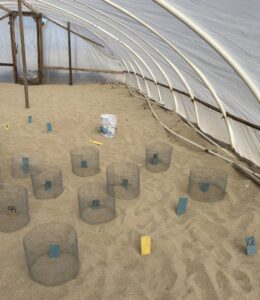 When we arrived, we met the other volunteers: a mother and her young daughter. The coordinator’s daughter gave us our orientation. Our job was simple: check the greenhouse nests every fifteen minutes for new hatchlings. If babies had emerged, we’d gently transfer them into containers filled with wet sand so they wouldn’t dry out before the evening release.
The greenhouse was exactly what it sounds like. A long plastic-covered structure built right on the beach, filled with sand. Inside, rows of numbered wire mesh cylinders marked each nest. It was hot. The sand was hot. The air didn’t move.
And the work was slow and repetitive. Check the nests. Record what you see. Wait fifteen minutes. Check again.
I loved every minute of it.
The slowness quieted me. The parts of me that plan and worry stepped back. There was nothing to figure out, nothing to fix. Just watch and wait. Pay attention to the nests. Between checks, we stood on the shore and spotted whales and dolphins in the distance.
The Release
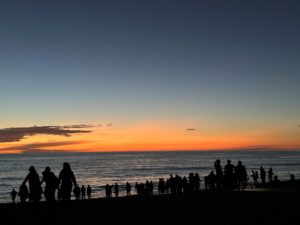 At sunset, the moment came. A crowd had gathered on the beach to watch. Locals, tourists, families, kids. My sister and I knelt in the sand with our blue bowls, carefully placing the tiny hatchlings on the line that marked the starting point of their journey.
They were so small. Dark and still in the wet sand, and then suddenly moving, flippers pushing forward.
Each one turned toward the water. Nobody told them where to go. They just knew.
The crowd went quiet. All of us standing there, watching these tiny things make their way across the sand toward the ocean. Nobody spoke. Nobody needed to.
I looked at my sister. She looked at me. We didn’t say anything either.
What Got Quiet
That night I thought about what had happened on the beach. Not just the turtles, but the stillness. My planning and worrying parts went quiet, and I was just present. Standing on a beach in Mexico, watching baby turtles crawl toward the ocean with my sister beside me.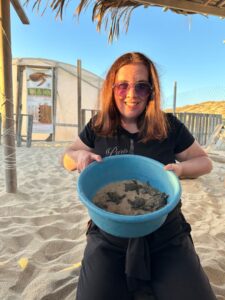
In IFS, Connectedness is one of the 8 Cs of Self. It’s the quality that lets us feel part of something beyond ourselves. The kind you feel in your body, not just understand in your head. The way I felt it standing on that beach.
Connectedness isn’t something we create. It’s something we access when our parts feel safe enough to step back. That evening, my busy parts didn’t need to protect me from anything. There was nothing to manage. And when they stepped back, I could feel what was already there: connection to my sister, to the volunteers, to the crowd of strangers, to those turtles, to the ocean they were heading toward.
In therapy, I see this happen too. I had a client whose manager parts loved to organize and clean. At family gatherings, she was always managing things before, during, and after the event. It kept her busy, but it kept her at a distance from the people she was there to be with. As she worked with those parts, she started practicing being more present. One day she told me about making cookies with some of the kids in her family. She just let go of everything and enjoyed the moment. She said, “I need to do more of that.”
A Reflection for Your Journey
Connectedness is something we all have access to. It shows up when we’re still enough to notice it.
- When was the last time you felt truly connected to something larger than yourself? What were your parts doing in that moment?
- Is there a part of you that stays busy or guarded in ways that keep connection at a distance? What might that part need to feel safe enough to soften?
- What is one small thing you could do this week to be still and notice the connections already around you?
This post is part of my monthly series exploring the 8 Cs of Internal Family Systems, a framework that shapes how I teach, write, and support healing. The 8 Cs are qualities described by Dr. Richard Schwartz, founder of the Internal Family Systems (IFS) model.

- Behind the name: Jack - October 12, 2026
- Behind the name: Sara - October 7, 2026
- Behind the name: Manuel - October 5, 2026
In my life, the places where I have felt true connection all seem to have a river running through them. In the spring, it was the quiet devotion of a pair of geese shepherding three goslings, alongside a sprawling family of ducks moving as one. By mid-summer, it became the acrobatics of a great blue heron, lifting and landing with an elegance that felt deliberate, almost ceremonial. In the fall, hawks flew low overhead, close enough to feel personal, as if reminding me of the importance of clarity and perspective. Each season offered its own lesson, drawing me into a deeper relationship with nature and into something spiritual, wordless, and steady.
I can’t wait to share my bird series soon. Maybe you can be a guest blogger. You seem to have lots of cool encounters with them as well.
I remember that day. I like what you said about not having to worry or think or plan. I don’t remember appreciating that. I think if we went back I would make it a point to just enjoy the quiet simplicity.
I think the best part that day was being together with you and all those people and watching as those little creatures made it to the water safely. It felt like a miracle.
That was an amazing experience! I would recommend it to anyone that loves nature, wildlife, and needs some time to slow things down and just enjoy being present in the moment.
I completely relate to that. I feel that on Saturday mornings when I’m able to sit on the porch and “just be” before the world wakes up. I love the silence and then the symphony of the animals around me waking up.